What Pottery Tells Us About Our Past
Imagine, for a moment, that five thousand years from now, an archaeologist digs up the ruins of your house. Your phone will have rusted into an unrecognisable lump. Your clothes will have rotted away. Even your furniture will have crumbled into dust. But that chipped teacup sitting in your kitchen, or the little clay lamp on your shelf – there is a good chance it will still be lying there, broken but recognisable, waiting to be found.
This is exactly what happens at archaeological sites around the world. When we dig into the layers of an ancient settlement, the single most abundant find is almost never gold, weapons, or jewellery. It is pottery- broken pieces of fired clay, known to archaeologists as potsherds. In most excavations, potsherds make up somewhere between seventy and eighty percent of everything found. So, it is worth asking: why did pottery survive so well, and what can these humble, broken pieces of clay actually tell us about the people who made them?
- Why Did Humans Start Making Pottery in the First Place?
This question sounds simple, but the answer is genuinely fascinating. For most of human history, people were hunter-gatherers, constantly on the move in search of food. If you are shifting camp every few weeks, heavy, fragile clay pots are the last thing you want to carry. So, for a very long time, there was simply no need for pottery.
Everything changed around ten to twelve thousand years ago, when humans began farming and settling down in one place. This shift is often called the Neolithic Revolution. Once people started growing grain, a new problem appeared: how do you store food safely for months at a time, away from rats, moisture, and rot? This is the moment pottery became not just useful, but necessary.
- A few practical pressures pushed humans toward inventing pottery:
- The need to store food. Grain, water, and oil all needed strong, long-lasting containers that could keep them safe for long periods.
- A revolution in cooking. Boiling food over fire made it easier to digest and far more nutritious than eating it raw. Pottery gave humans, for the first time, a reliable way to boil food and water.
- A settled way of life. Once people stopped moving constantly, heavy and breakable containers stopped being a burden and became a genuine convenience.
- Easy access to raw material. Almost every early settlement was located near a river, and clay was cheap, abundant, and simple to work with.
In short, pottery was not a random invention. It was a direct response to a changing way of life. It is no coincidence that around the same time humans learned to till the soil, they also learned to fire clay.
- Why Do Broken Pieces of Clay Matter So Much?
Once clay is fired at high temperature, it becomes chemically very stable. Wood rots. Cloth disintegrates. Leather decays. But fired clay can survive underground for thousands of years with barely any damage. This is precisely why potsherds dominate the archaeological record at almost every settlement site on earth.
Because of this durability and abundance, pottery is often called the “alphabet” of archaeology. Just as we need an alphabet to read a language, archaeologists need pottery to read an ancient culture.
- What Is the Study of Pottery Called?
The scientific study of pottery is known as ceramic studies, or sometimes ceramology. It is a specialised branch of archaeology that examines the shape, texture, decoration, and manufacturing technique of ancient pots in order to reconstruct how people once lived – what they ate, how they traded, what they believed, and how advanced their technology was.
- How Do Archaeologists Actually “Read” a Pot?
This process is a lot like detective work, and even a single broken fragment can reveal a surprising amount:
- Typology (shape classification). Pots are first sorted by shape and function – bowls, plates, storage jars, cooking pots, lamps, and so on. This gives archaeologists a picture of everyday life and household activity.
- Stratigraphy (layer analysis). In archaeology, lower soil layers are generally older than the layers above them. By noting which type of pottery appears in which layer, archaeologists can build a relative timeline – even without a single written date.
- Fabric analysis. By examining what was mixed into the clay – sand, straw, mica, or crushed shell – researchers can tell whether a pot was made locally or brought in from elsewhere through trade.
- Decoration and style. Painted lines, geometric patterns, and surface designs reveal the artistic sensibilities and cultural identity of the people who made them.
- Manufacturing technique. Was the pot shaped entirely by hand, or thrown on a potter’s wheel? Wheel-made pottery generally signals a more technologically advanced and organised society, often linked to specialised, full-time craftspeople rather than casual home production.
- A Timeline in Clay: Different Cultures, Different Pots
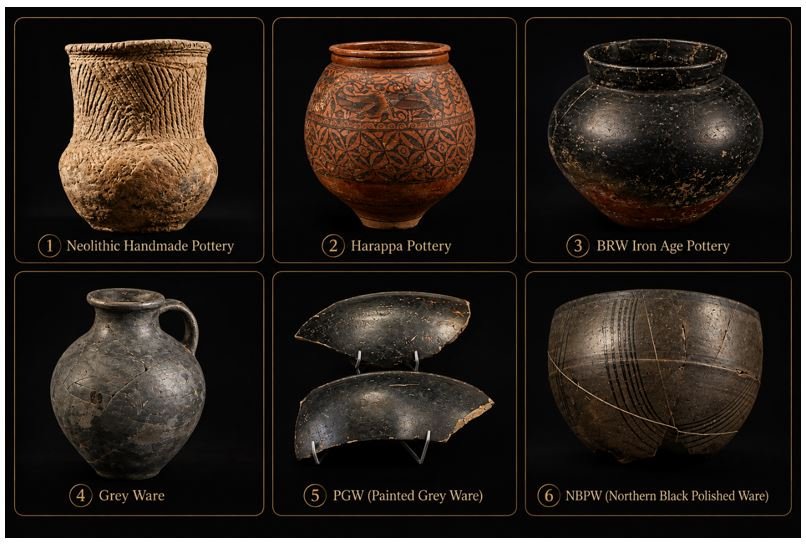
Here is something genuinely interesting – every era and every culture had its own distinctive style of pottery, almost like a fashion trend of its time. In the Indian subcontinent, this evolution looks roughly like this:
- c. 7000–3000 BCE – Early handmade pottery. Sites like Mehrgarh (in present-day Pakistan) have yielded some of the earliest handmade pots, marking the beginnings of settled, farming-based life.
- c. 2600–1900 BCE – The Indus Valley Civilisation. This period produced elegant red pottery decorated with black geometric and floral designs, thrown on a wheel – clear evidence of advanced craft specialisation.
- c. 2000–1500 BCE – Ochre Coloured Pottery (OCP). Associated with the Chalcolithic (Copper Age) cultures of the Ganga-Yamuna doab region in northern India.
- A long span across periods – Black-and-Red Ware (BRW). Found widely across India, from the Chalcolithic through the early Iron Age.
- c. 1200–600 BCE – Painted Grey Ware (PGW). Linked to sites such as Hastinapur, often associated with the Mahabharata period. This pottery is known for its fine grey fabric and delicate black painted designs.
- c. 700–200 BCE – Northern Black Polished Ware (NBPW). A hallmark of the wealthy, urbanised society of the Mauryan and pre-Mauryan period. Its surface has a glossy, almost mirror-like shine that still puzzles researchers today, since no ancient kiln technology should have been able to achieve it so consistently. Sites like Pataliputra and Vaishali in Bihar have yielded this ware in large quantities.
Together, these pottery styles form what could be called a “ladder through time” – allowing archaeologists to travel thousands of years into the past, layer by layer, without needing a single written record.
Source: Internet
- Bringing in the Lab: The Scientific Study of Pottery
Modern archaeology no longer relies on visual inspection alone. Pottery is increasingly studied using sophisticated laboratory techniques:
- Thermoluminescence (TL) dating. This technique measures when a pot was last fired, giving archaeologists a fairly precise age for the object.
- Petrographic analysis. Examining mineral grains in the clay under a microscope helps determine the geographic origin of the clay, and by extension, whether the pot was locally made or imported.
- Chemical and elemental analysis (such as XRD and INAA). These methods reveal the chemical fingerprint of the clay, which can be traced back to specific trade routes and source regions.
- Residue analysis. This is arguably the most exciting technique of all. Even after thousands of years, microscopic traces of what a pot once held can survive – fats, oils, plant starch grains, and phytoliths (microscopic silica structures unique to specific plants) can all get trapped in the tiny pores of the clay. By chemically analysing these residues, scientists can determine, with real confidence, what a pot was once used to cook, store, or serve – whether that was milk, meat, wine, or a particular spice.
- When a Broken Pot Solved a Real Mystery
Here is a concrete example that shows just how powerful this science can be. For a long time, archaeologists debated whether the people of the Indus Valley Civilisation, roughly four to five thousand years ago, used spices in their cooking, and if so, which ones. Researchers examined pottery and dental calculus (hardened plaque on ancient teeth) from Harappan-era sites such as Farmana in Haryana, using microscopic residue analysis.
The results were striking: researchers found microscopic residues of turmeric, ginger, and even banana on the pottery. This confirmed that people in the Indian subcontinent were already cooking with turmeric and ginger four thousand years ago. In other words, India’s famously spiced cuisine is not a recent development at all – it stretches back millennia. A single, unremarkable-looking fragment of clay helped answer a question that no written record from that period could ever have settled.
Another compelling case comes from Northern Black Polished Ware. For decades, scholars debated how ancient potters achieved such a glossy, mirror-like finish without modern kiln technology. Scanning electron microscope (SEM) analysis eventually revealed that the shine came from an extremely fine clay “slip” coating combined with precisely controlled firing temperatures. This told researchers something remarkable: potters working nearly two and a half thousand years ago already possessed a highly sophisticated understanding of material science.
- So, What Can One Broken Sherd Really Tell Us?
Pulled together, the study of pottery can reveal:
- Chronology – roughly when a site was occupied.
- Diet and food habits – through residue analysis, what people were actually cooking and eating.
- Trade and cultural contact – pottery from distant regions signals contact with other cultures.
- Technological development – the shift from handmade pots to wheel-thrown, glossy-
finished ware traces real technical progress.
- Social and economic structure – differences in the quality and finish of pottery can hint at wealth and social hierarchy within a community.
- Religious and ritual life – burial urns and ritual vessels offer glimpses into ancient beliefs and practices.
- A Final Thought
The next time you walk past a dull, chipped clay pot in a museum case, take a moment to pause. That fragment may once have sat in a kitchen thousands of years ago, while someone cooked a meal for their family. Scattered across the ancient soil of Bihar and the wider Indian subcontinent, these humble pieces of fired clay are, quite literally, history written in earth – waiting only for someone willing to read them.