The Silence of Vaishali: A Pilgrimage Through Time at the World’s Oldest Stupa
The heat of the Bihar plains has a way of humbling you. But as I stepped off the dusty road in the village of Basarh, expecting nothing more than a crumbling ruin, I felt a sudden, sharp drop in temperature—and a profound sense of peace.
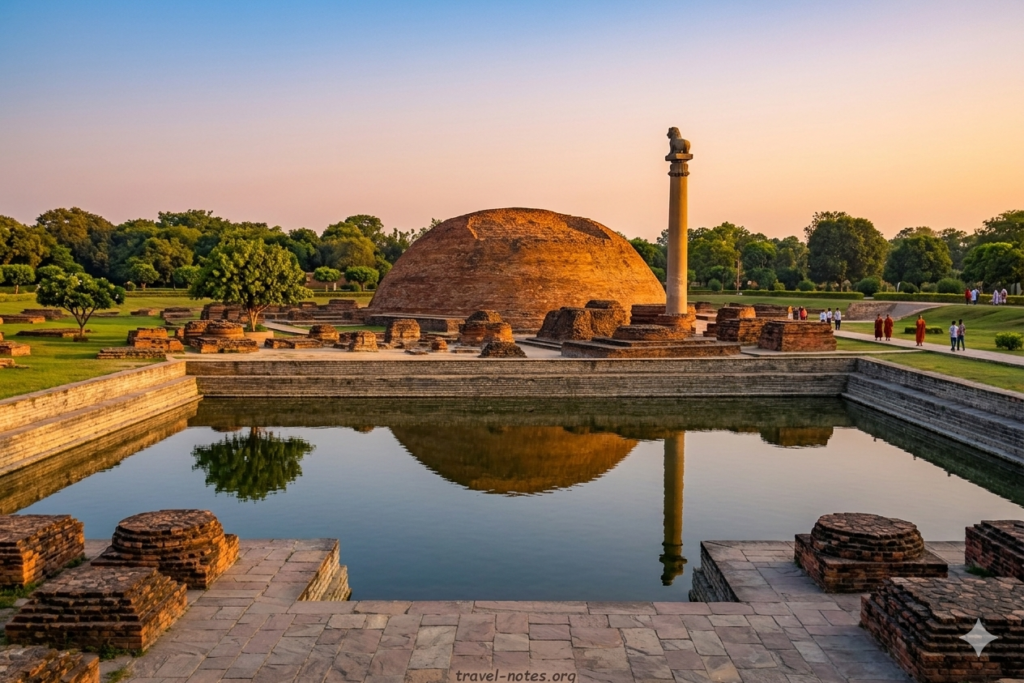
I had arrived at the Vaishali Stupa. There were no neon signs, no souvenir hawkers, and for a long while, no other tourists. Just a modest brick mound, rising from manicured lawns, holding within its core the silent, undeniable truth of the Buddha’s physical existence. This is not just a monument; it is the echo of the first silence that followed the Buddha’s passing, a tangible relic that connects the modern world to the origins of Buddhist faith.
A Republic of Clay and Ash: The Story of the Relic Stupa
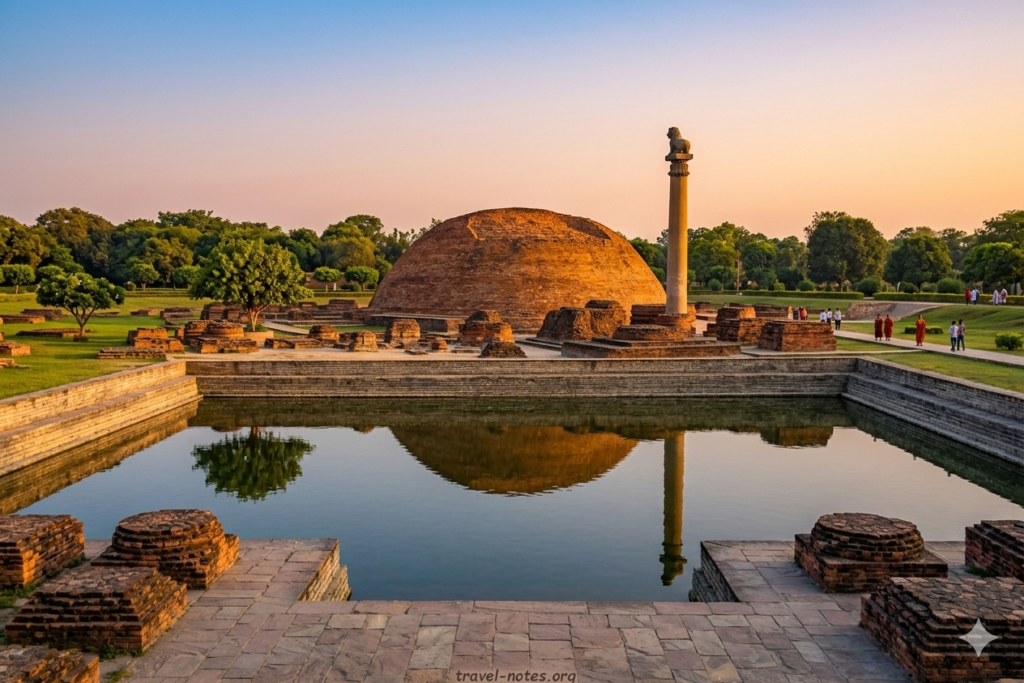
To stand at the Vaishali Stupa is to stand at the very beginning of Buddhist architecture. While giant stone temples capture the imagination, this modest clay and brick structure predates Emperor Ashoka by centuries. It is widely regarded as the earliest archaeologically known stupa in the world, dating back to the 5th century BCE. Built by the powerful Licchavi clan, who ruled what historians consider one of the world’s first republics, it was originally a mud mound—a simple yet profound gesture of devotion.
When the Buddha attained Mahaparinirvana, his remains were divided into eight portions. The Licchavis of Vaishali received their share and enshrined it here. For centuries, the location was lost to history, buried under the soil. It wasn’t until 1958 that the K. P. Jayaswal Research Institute began excavations, eventually uncovering the stupa’s clay core. Inside, they found a soapstone casket—a time capsule from the Iron Age containing the holy ashes of the Lord, mixed with earth, a golden leaf, a conch piece, and beads. That relic casket now resides in the Patna Museum, but the spiritual resonance of its original resting place remains untouched.
Key Historical Milestones of the Site:
| Feature | Description |
| Original Name | Relic Stupa of Vaishali (Stupa I) |
| Dynasty | Licchavi Republic (c. 5th century BCE) |
| Material | Earth core with later brick enlargements (Mauryan/Sunga) |
| Key Find (1958) | Soapstone reliquary with Buddha’s ashes |
| Current Status | Tentative UNESCO World Heritage Site (Silk Road Sites in India) |
The Lion’s Roar: Ashoka’s Pillar and Ananda’s Legacy
Just a mile and a half away from the Relic Stupa lies Kolhua, the second heart of the Vaishali archaeological complex. Here, Emperor Ashoka—the great Mauryan ruler who transformed Buddhism into a global religion—erected a magnificent polished sandstone pillar. Known as the Ashokan Pillar or Singh Stambh, it is a masterpiece of engineering. Carved from a single piece of red sandstone, it rises 18.3 meters high, topped by a life-sized lion facing north, the direction the Buddha took on his final journey. This pillar is notably un-inscribed, a rarity among Ashokan relics, and remains one of the best-preserved pillars of the Mauryan era.
Next to the pillar sits the Ananda Stupa, dedicated to the Buddha’s most beloved disciple and constant companion. Ananda is a deeply human figure in Buddhist lore—he was by the Buddha’s side for 25 years and was renowned for his incredible memory, reciting the Buddha’s teachings at the First Buddhist Council. Legend says that as Ananda approached Mahaparinirvana, he traveled from Magadha to Vaishali by boat. To prevent his relics from falling into the hands of only one kingdom, he ascended into the air and cremated himself in mid-flight, causing his ashes to fall equally across the two kingdoms. The stupa in Kolhua, flanked by Ashoka’s might, marks the place where his followers enshrined his remains.
A Revolution in the Sangha: The First Nuns of Vaishali
Beyond the stone and brick, Vaishali is hallowed ground for a different, often overlooked reason: women’s empowerment in the spiritual realm. This was the site of a quiet revolution.
After years of requests and the intercession of Ananda, the Buddha finally relented here in Vaishali. He allowed his foster mother, Mahaprajapati Gautami, to be ordained, thereby founding the first order of Bhikkhunis (Buddhist nuns). Walking through the excavated monastic complexes, you can almost feel the weight of that decision. This wasn’t just a religious ritual; it was a radical social shift in the Iron Age of the Gangetic plains. For the first time, women had a sanctioned path to renunciation and spiritual authority outside the domestic sphere.
A Fresh Perspective: Walking the Path with Monks
The energy of the site is best captured by the stories of those who visit. Pilgrims often describe the silence of Vaishali as a “physical presence,” different from the chaotic bustle of India’s streets. One Toronto Zen Sangha member, writing about their pilgrimage, noted: “I felt surrounded by love. Everything was so peaceful, so suddenly quiet, and India isn’t often quiet. Vaishali is a vast sprawling space, with a high canopy of trees that are like umbrellas. Vaishali was the first place where women were ordained. It was incredibly moving…”
During my own walk around the Vishwa Shanti Stupa (or World Peace Pagoda), which stands nearby, I observed a group of monks from the Nipponzan Myohoji sect. They were performing a circumambulation (Kinhin) in perfect rhythm around the white marble dome. Their serenity was contagious, a stark contrast to the pot-holed roads leading to the site. If you visit during the morning or evening prayers, you might witness these ceremonies—a living tradition that makes the Vaishali Stupa a site of active worship, not just a dead historical park.
The Dawn of a New Era: The 2025 Inauguration
In a major leap forward for heritage tourism, 2025 marked a watershed moment for Vaishali. In July, Bihar Chief Minister Nitish Kumar inaugurated the ‘Buddha Samyak Darshan Museum and Memorial Stupa’.
This is a different kind of structure. While the ancient Relic Stupa is about preservation, this new monument is about engineering prowess. For the first time in modern Indian history, a stupa has been constructed using only sandstone blocks, joined with a tongue-and-groove technique without cement, bricks, or concrete. Inaugurated in the presence of monks from 15 countries, the complex stands 72 acres tall (with a height nearly double that of the Sanchi Stupa) and features a grand gate modeled after the Sanchi Torana. Most importantly, it houses the sacred relic casket of the Buddha on its first floor, making it a new focal point for global pilgrimage.
Planning Your Pilgrimage: A Practical Guide
Vaishali is no longer the remote jungle ruin it once was. With the expansion of Bihar’s Buddhist Circuit, travel has become significantly easier. The launch of the Koderma–Vaishali MEMU train has greatly improved connectivity, linking Vaishali directly to other key stops like Nalanda and Rajgir.
How to Reach:
– By Air: Lok Nayak Jayaprakash Airport (Patna) is roughly 55 km away.
– By Rail: Hajipur Junction is the nearest railhead. However, the new MEMU services now directly connect major pilgrimage hubs.
– Best Time to Visit: Between November and February. The winter temperatures (15-25°C) make the long walks bearable.
– Key Tip: While the stupa park is wheelchair-friendly and accessible, the approach roads for local transport (like the cycle-rickshaws linking the sites) can be bumpy. Hiring a guide for the day (approx. INR 300-500) is highly recommended to understand the layers of history.
The Final Reflection
The Vaishali Stupa is not the tallest or the most ornate structure in the Buddhist world. It is a mound of mud and ancient brick. Yet, its silence speaks louder than the gilded statues of other places.
Here, the Buddha delivered his last sermon. Here, the first nun was ordained. Here, Ashoka placed his lion. And here, in a glass casket across the river in Patna, lies a handful of ash—proof that 2,600 years ago, a man walked this earth and found a way to end suffering.
Whether you are a history buff tracing the origins of the republic, a spiritual seeker looking for quiet reflection, or a traveler ticking off the Buddhist Circuit, Vaishali offers something rare: a genuine encounter with origin.
Have you visited the Buddhist sites of Bihar?
I’d love to hear about your experience standing under the Ashokan lion or meditating at the peace pagoda. Drop a comment below, share this post with a fellow history lover, or Subscribe to our newsletter for more deep dives into India’s hidden archaeological wonders!